Wednesday, January 30, 2019

Kamala Harris Declares Candidacy for 2020 Presidential Election


Kamala Harris, a California Democrat and the second black woman to serve in the Senate, recently declared her candidacy for president last Monday. Harris symbolically announced her candidacy on MLK day and also aimed to commemorate Shirley Chisholm, the first woman to seek the Democratic Party’s nomination for president 47 years ago. The core of Harris’s campaign is her emphasis on “the people.” Her signature proposal is focused on individuals and would provide lower-income families with monthly cash payments of up to $500. She has also proposed a bail reform bill, and her initial Senate work was focused on lowering maternal death rates, particularly among black women. Supporters of Harris have claimed that she provides a balance between emphasizing public safety and civil rights ideals. However, those who are skeptical of Harris claim that she needs to break with her past as a prosecutor who previously supported the death penalty and a measure that sought to punish parents for chronically truant children. Recently, Republicans have argued that Kamala Harris is unqualified and out of touch with her brief time in the Senate being characterized by a radically liberal voting record. Harris is still not yet well known to voters, but has gained some attention from her interrogations of Trump administration officials. She currently has a centrist standing within the Democratic Party, which could be beneficial for her since she is not linked to a single faction.

1. Do you think Kamala Harris is qualified for the presidency?
2. Given the high number of low-income families and the rising number of minorities in the population, do you think Kamala Harris will garner enough support for her campaign?
3. In order to be successful, do you think Kamala Harris needs to break from her past as a prosecutor especially since she has recently tried to appeal to leftist voters?


Tuesday, January 29, 2019

Former Starbucks chief Howard Schultz confirms interest in independent 2020 bid, as Democratic worries rise


Link
Former Starbucks chief executive Howard Schultz said Sunday that he is preparing to launch an independent
campaign for president, rebuffing growing Democratic concern that such a move would help re-elect President
Trump. A self-funded independent campaign by a well-known billionaire focused on attacking the two-party
duopoly that has long defined presidential politics has the potential to reshape the dynamics of the race.
“Not only the fact that this president is not qualified to be the president, but the fact that both parties are consistently
not doing what’s necessary on behalf of the American people and are engaged, every single day, in revenge politics,”
states Schultz. Democrats fear a credible third-party candidacy could allow Trump to win states he otherwise would
have lost or push a decision on the election to the U.S. House, where Republicans currently have an advantage in
the number of state delegations they control. Their worry is that a three-way race would split Trump’s opposition,
while the president’s support would remain intact. His interest in an independent campaign is based on the recent
ideological drift of both political parties, which have embraced more ideologically ambitious proposals in recent
years, even as the number of Americans registering as independents has risen. Schultz also has said the country
needs to “go after entitlements,” programs such as Social Security and Medicare, and favors a path to citizenship
for undocumented immigrants and rejoining the Paris climate accords, and he criticized the Democratic promise
of “free health care” for all as unrealistic.


Questions:
1.Do you think Schultz’s decision to run as independent will indirectly help Trump in re-elections?
2.How do you think Americans will vote, due to Schultz’s inexperience in politics?
3.Why do you think there is a rise of wealthy businessmen running to be our president? Do you think they are qualified to become the president?

Monday, January 28, 2019

When Seeing Is No Longer Believing: Inside the Pentagon’s race against deepfake videos


Seeing is believing they say... well not anymore! Last year, Buzzfeed released a viral video which used Obama's face to say many things that weren't expected. Now, many people knew something was off from the start, but it was the mark of a new era of "fake news." This technology is only getting better and the government is looking for a way to detect these deepfakes. Several universities and companies have been trying to make the technology even better just to figure out how to detect if the video is fake. However, it isn't just the visual we have to worry about, fake audio is another aspect that these companies are trying to combat. The Pentagon has invested apparently a lot of money for these fake videos. Deepfakes are potentially a huge issue for everyone. Misinformation is already a huge issue, but now audio and video, "the bedrock of truth," are no longer reliable. There are already those who don't believe in things that have video proof like the Holocaust, 9/11, the moon landing, or even a round earth. What happens to videos that are real? People can claim that they aren't real. Like if someone says something sexist or racist, they can claim it wasn't real? What is going to happen when these videos become more prevalent? How can we protect ourselves from this misinformation while we wait for the technology that can detect deepfakes to be ready for public use? In Junior year history, we learned about credibility for news sources and articles. Should we start to learn about the credibility of videos? What other concerns should companies and the government be concerned about with deepfakes?

Also, if you think you are good at determining what is fake or not, the link above has a little detection quiz.

Government shutdown cost economy $11 billion, budget office says


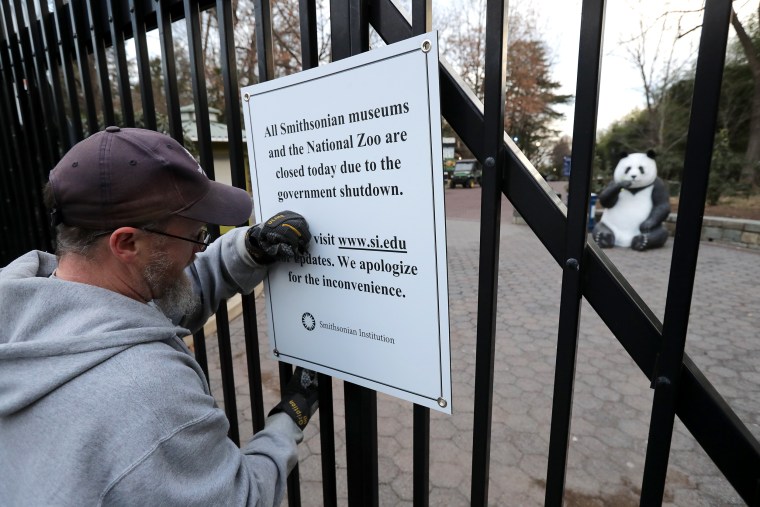
Image: A Smithsonian National Zoo employee removes a closure sign after the zoo reopened at the end of the partial government shutdown on Jan. 28, 2019.
After the longest government shutdown in US history, the government has reopened Monday. During the shutdown, all federal employees deemed "essential personnel" such as the TSA and FBI were forced to work without pay for weeks. The shutdown has affected these people as they have gotten behind on bills and some have been forced to apply for food stamps. Some employees have also called in sick and cited financial reasons for their absence, which caused workplaces to be understaffed, like airports, which ended up having wait times of over an hour. Federal employees were not the only people affected by the shutdown. The US economy has lost $11 billion, $3 billion of which has been lost forever. The shutdown may be over but it will have lasting effects on the economy.

Discussion Questions:
1. What do you think of the shutdown? Was anyone trying to solve the shutdown?
2. With the shutdown over, do you think there will be any lasting effects on people or the economy?
3. Are there any measures that can be taken in order to avoid another long shutdown?


Polarization at the state level in an era of divided government


Article link
                                          Minnesota State Capitol, by Tim Gruber, NY Times

After watching the Democrats flip 40 seats to take control of the U.S. House of Representatives and the Republicans gain two seats to widen a narrow margin in the Senate, Minnesota remains the only state that joins the national government with a split legislature. Among the other 49 states, Republicans control 31 legislatures and Democrats control 18 legislatures. A few liberal initiatives have emerged in states where Democrats gained full control of both legislative chambers such as a ban on firearms in the New Hampshire House, a bill to offer undocumented students financial aid in New York, and bills to expand affordable health care in Colorado. Meanwhile, conservative legislatures are moving to ban abortions as early as six weeks into a pregnancy in Ohio, new right-to-work laws in Missouri, and more prison construction in Alabama.

Discussion Questions
1. Is the polarization in state level politics the result of state legislators following the lead of national lawmakers or simply following the will of voters in the state?
2. How might Minnesota's divided legislature be similar to or different from the divided legislature at the national level?
3. With states taking clear liberal or conservative positions, how might this impact next year's presidential election?

Wednesday, January 23, 2019

Los Angeles Teachers' Strike Ends as Deal is Reached

This past Tuesday, Jan. 22nd marked the end of a week long strike put on by thousands of Los Angeles teachers. Affecting hundreds of thousands of students, the strike was a huge hit to the public education school system, but brought the change needed for better conditions.
Viewed as a major success for LA public schools, improvements include: caps on class sizes, full time nurses at schools, librarians at every public middle and high school by 2020, reducing the amount of standardized testing, caps on the amount of charter schools in the state of California and a 6% pay raise for all teachers.
Surprisingly, the unionized teachers under unions such as Red for Ed and United Teachers Los Angeles were protesting against democratic leaders. During the Obama Administration, the previous President pushed for the expansion of high-quality charter schools while pushing back against teachers' unions. However, democratic leaders such as Kamala Harris -- who has also recently announced her candidacy for president in 2020 -- supported the striking teachers.
The controversy surrounding public schools versus charter schools is complicated and both sides are supported fairly equally. Those in favor of less charter schools, including the teachers that were on strike, argue that those schools compete with public schools for students and funding and therefore place immense strain on public school programs. Those in favor of charter schools believe that they offer different options for parents and are based on the reasoning of education bureaucracy.
Despite the agreement to pay raises and increased resources, the inevitable question remains: how will the public school system fund these advancements?
One option that's being heavily considered is a parcel tax, which is a property tax that is not based on property value. Unlike most taxes, it doesn't take into account property or income values, meaning that those living in a small house in an average neighborhood pay the same amount as corporate owners of a huge apartment building. There's also been talk of placing a parcel tax on properties that are only labeled as commercial buildings and properties, which the school district and unions both agree with and are pushing for.
Overall, I'm impressed and extremely happy with the progress our public school education system is making. I think decreasing charter schools is a great solution to bring back students and funding to public education programs, as I view charter schools as a way of escaping the true problems of our education system. I believe we should focus on improving our existing system in order to ensure fairness, equality and improvement for all students, instead of simply creating new privately owned schools that take away from public funding.
Questions:
1) What is your opinion about charter schools? Do you believe they are an effective solution to our issues in public education or not? Why or why not?
2) According to the article, the strike cost the district $125 million in state financing. Do you believe the strike was effective enough to dismiss these immense costs? Essentially, was the strike worth the money?
3) Have you attended a private or charter school? What is different and what is similar? In your opinion, which was a better option and which provided a stronger education?
4) Do you have any short or long term ideas for solutions involving this issue? What can be done?
Link to article: https://www.nytimes.com/2019/01/22/us/la-teacher-strike-deal.html

Tuesday, January 22, 2019

'Black Panther,' 'Roma' lead Oscars into new frontiers

Image result for black panther roma


With the Oscar date nearing, February 24th, the Academy finally released this year's nominations. Many people were pleasantly surprised to see that Marvel’s Black Panther and Netflix’s Roma made the cut for Best Picture. Both movies received critical acclaim last year, with Black Panther as one of the highest grossing films in 2018.
Both Black Panther and Roma are considered as forces to new frontiers in the Oscars due to their cultural and historical significance. Black Panther was praised for its cast that mainly included people of color and its success at the box office. Not to mention, it is the first superhero and Marvel title to be nominated for best picture. On the other hand, Roma, has garnered a lot of success despite belonging in the less popular, black-and-white genre. Many Netflix users loved the movie for its unique subject and international appeal. Overall, these two movies have attracted the attention of many due to the stories they portray and their representation of people of color.
The Oscars has been criticized many times before for failing to recognize films that deviated from the traditional, “issue-oriented dramas” that mainly showcased white actors. In the past, people have popularized #OscarsSoWhite hashtag in protest of the awards institution. So, the Academy’s recognition of movies that made an effort to represent people of color in film has been long awaited. Personally, despite the Academy’s problematic past, I find it gratifying that amazing movies such as Roma and Black Panther finally get the recognition that they deserve. The Academy still has a lot of influence in show business and the nomination of such diverse movies can only pave way for more representation in Hollywood.

Questions:
  1. Why did the Academy decide to nominate Black Panther and Roma for Best Picture despite them being unconventional options?
  2. Why did these movies garner so much support?
  3. How will the nominations of these movies affect the masses? Hollywood?
  4. Should Black Panther and Roma be nominated for Best Picture?

Supreme Court Revives Transgender Ban for Military Service

https://www.nytimes.com/2019/01/22/us/politics/transgender-ban-military-supreme-court.html?action=click&module=Top%20Stories&pgtype=Homepage

Since the 2016 decision under the Obama administration, which allowed transgender citizens to serve in the military, approximately 9,000 individuals who identify as transgender have volunteered to join the Armed Services, according to CNN. However, President Trump has attempted to halt and overturn this decision since the beginning of his term in 2017. In a recent SCOTUS decision, the Court came to a 5-4 decision which overturned the policy enacted during the Obama administration, thus preventing transgender citizens from enlisting in the U.S. Armed Services.

Even in an era following Obergefell v. Hodges (SCOTUS decision which upheld gay marriage) and an increasing prominence and support for the entirety of the LGBTQ+ community, it shocks me that the current administration is preventing certain groups of people for volunteering to serve for our country. In order to serve in the military, one must possess immense strength and honor for the country, and I believe that the Supreme Court's decision invalidates and overlooks the great sacrifice these citizens are making by enlisting.

The topic of civil rights for minority groups is a highly contested issue throughout the nation, and this recent decision serves as yet another example of the great polarization present in the United States today.

Questions:
1. In the case of a draft, do you believe that the Trump administration and/or the Supreme Court would uphold their current position on the issue of transgender enlistment? Why or why not?

2. The 5-4 decision was split according to party affiliation, as all 5 conservative justices supported the ban of transgender enlistment. How do you believe this divided Court will impact future rulings? Should the validity of 5-4 rulings be re-evaluated in the event of such polarization we face today?


Monday, January 21, 2019

Women's marches kick off with focus on 2020 and progressive policies

This past Saturday, thousands of demonstrators gathered in Washington D.C. and other cities across the nation in hope to use their voices and common cause against Donald Trump and into more progressive policies. For the third year in a row, marchers are going to rallies in Washington’s Freedom Plaza, New York, and many more places. The first Women’s March occurred in January, 2017 as a form of resistance to Trump’s election, and at the begin of 2018, the movement shifted to focus on midterm elections. This year in specific, organizers say that the marches not only serve to commemorate victories for the Democratic Party women of color in the midterms, but also to push for more progressive laws that can assure greater protection for women across race, class, and sexual orientation. This agenda includes aspects such as including immigrants rights, violence against women, civil liberties and rights, as well as climate change.
Some of the scheduled speakers are New York City first lady Chirlane McCray, women’s rights activist Gloria Steinem, and US Representative Alexandria Ocasio-Cortez, who’s strong advocacy for more progressive policies has made her a very high profile Democrats in the House. She stated that “all of these women are coming together in solidarity with each other, to support each other and to make sure that every single voice is amplified, protected and advanced in the United States of America” (CNN).
Overall, I think that these marches demonstrate some of the concerns about diversity and inclusion that have affected various groups and individuals across the country. The demonstrations allow for people to come together and share their common hopes for the future, and try to positively influence policymakers when debating new legislation. This event connects to both world history and international relations because people not only in the U.S., but also around the globe participate in these marches, raising the question of what pressing policy conflicts need to be addressed. 

1. In your opinion, are these nation-wide marches effective in influencing future policy?
2. Do you believe that this year’s women’s march could bring more attention to the presidential election of 2020? Explain.
3. How could the open backlash against Donald Trump and his policies voiced in the women’s marches affect his chances at reelection? 

Tuesday, January 15, 2019

Kirsten Gillibrand to Run For President in 2020

Kirsten Gillibrand, a third-term New York Senator, announced Wednesday, January 15th that she will be running for President in the 2020 election. In her words, she is going to run for president "because, as a young mom, I'm going to fight for other people's kids as hard as I would for my own." A few main points of her campaign will be healthcare (which "should be a right and not a privilege"), improving public education, job training, and taking on interests that stand in the way of progress.

According to Gillibrand, "You are never going to accomplish any of these things if you don't take on the systems of power that make all of that possible, which is taking on institutional racism. It's taking on corruption and greed in Washington, taking on the special interests that write legislation in the dead of night and I know that I have the compassion, the courage, and the fearless determination to get it done."

She plans to begin her campaign in her hometown of Troy, New York, which she also plans to make her campaign headquarters. She will follow this with a trip to Iowa this weekend. She is expected to center her campaign on the women's issues that have been the signature of her career, and is likely to focus more on gender issues than other candidates.

Questions:
1. What added consedirations and pressures come with running as the potential first female President?
2. How will the changes made during Trump's time in office influence voters in the 2020 election and how will this affect Gillibrand as a candidate?
3. How will the #MeToo movement help propel Gillibrand's campaign?

Theresa May's Brexit Deal is Defeated by British Lawmakers

Theresa May is the current British prime minister and just recently had her Brexit plan voted down by British lawmakers. The final vote on Brexit was 202 yes’s, and 432 no’s. She only has until next Monday to come up with a new deal to replace her Brexit one. However, this staggering defeat has even more immense implications for the British government and for prime minister Theresa May.

Not only did Theresa’s plan fail to pass, the opposing party in government has called for a vote of no confidence. This means that Theresa May could potentially lose her seat of prime minister. The opposition Labour Party has called her government “sheerly incompetent” and could win an early general election if Theresa May loses the no confidence vote. The failure of her Brexit plan was costly for Theresa May as it lowered the confidence her supporters have in her to run the government. If she cannot regain the British lawmakers support, she could lose her position in government.


Questions:
  1. What is your opinion on Theresa May’s Brexit plan?
  2. How do you think political parties are affecting the British government? How does this compare to the American government?
  3. Do you think Theresa May has a chance to regain support from British lawmakers? Why or why not?

Sources:

The Impact of the Government Shutdown Is About to Snowball

Image result for government shutdown impact on national parks Image result for government shutdown impact on airports

For the longest time ever, the Trump Administration has shutdown the entire government. Starting on December 22nd and continuing still, the shutdown has left many federal employees without a salary for weeks on end. President Trump has tweeted previously that this shutdown could last “months, or even years.” In 2013, Obama had also shutdown the government, but unlike Trump’s, that one only lasted 16 days, after which everything returned to regular function without horrible consequences.


First of all, the regular functions of the government have all stopped. National parks and museums are left empty; we have delayed health and food inspections; the food stamp payments have been halted, leaving many families in deeper poverty than ever before; federal court funds are declining, which has prevented farm and housing loans from being processed. If the shutdown continues, the economy will decline at a shockingly, rapid pace, resulting in many families in debt.


However, there is still hope for government agencies to do the work they usually do. While each has designed a plan in the case of a shutdown, they know that at some point work must resume in order to ensure public health. For instance, the Food and Drug Administration has a bit of leeway when it comes to the shutdown because if they are not functioning then we put the health of the American people at risk. There are ways to move the sums of money around in the government, giving agencies a bit of discretion even in a shutdown.


What I found most surprising, personally, is that if the Democratic party tries to mitigate the effects of the shutdown, it allows the Trump administration to prolong the shutdown because it has a lessened impact on the people. The more I learn about the shutdown, the more I am shocked at the fact that it is still going on even though it has a clear negative effect on hundreds of families.


Questions:
  • Is there anyway to reach a compromise and satisfy both sides of the political divide? What would each side have to give up to achieve a resolution?
  • What do you think is the most likely ending to the shutdown? Will either side just give up? Will a compromise be made?
  • Do you think that government officials should work to mitigate the effect of the shutdown on the country with the risk of a longer shutdown?

Court Blocks Trump Administration from Including Citizenship Question on 2020 Census


After much contention, a New York judge has blocked the Commerce Department from including a question that would have asked whether or not an individual was a citizen of the United States in the upcoming census. The ruling is a large victory for advocacy groups and local officials that have been asking for the question not to be included in the census. It has not been since 1950 that the question of citizenship has been included in a census. The decision outlined that the question would make it so that the Commerce Department would not be fulfilling its constitutional duty to count every single person in the United States, regardless of citizenship, because people in the United States illegally would not be inclined answer the census. Analysts believe the decision was motivated both by Republicans wanting more representation, illegal immigrants tend to live in areas with a Democratic majority so the representation of those areas would be limited, and by the president wanting account of non-citizens living in the United States for the purpose of deporting them. The Commerce Department argued that the question would be necessary to uphold section two of the Voting Rights Act, prohibiting practices that discriminate on the basis of race, since this would be essential data for the Justice Department. This claim turned out to be false because it was revealed that the Justice Department had never requested the question to be included, rejecting what Commerce Department claimed. According to the judge rendering the decision, this is likely to be challenged in the 2nd U.S. Circuit Court of Appeals and later the Supreme Court.


  1. Do you believe the Commerce Department should be allowed to include a question in the census that asks about the responder's citizenship status?
  2. Would the inclusion of the question provide valuable information for preventing discrimination?
  3. How would a question about citizenship on the census affect the outcome of the census?

Friday, January 11, 2019

Missing teen Jayme Closs found alive

This is an ongoing story: https://www.cnn.com/us/live-news/jayme-closs-wisconsin-found/


About 3 months ago, in Barron county, Washington, a manhunt began for Jayme Closs, who disappeared on the same night that police found her home broken into and her parents shot dead. Today, she reappeared on the streets Barron county, and was quickly recovered by police and sent to a nearby hospital. Meanwhile, police also arrested a suspect Jake Thomas Patterson and is now being formally charged with kidnapping and the murder of Jayme's parents.


However, in the time before she was found, lots of unsavory theories ran rampant:
  1. A Meth dealer found the wrong door to confront someone
    1. “This is the No. 1 problem in northwestern Wisconsin,” Barron County Sheriff Chris Fitzgerald on methamphetamine
  2.  "James or Denise Closs could have killed their daughter earlier in the day outside of the home, killed their spouse, then took their own lives. " 
  3. An abductor Jayme met online or a secret boyfriend committed the crime
  4. Closs herself murdered her parents

If I were a relative, I would be quite offended by the last one. Then again, speculation by the public can sometimes help the police investigation.

Do you think rumors and speculation by the public is good (helpful), or bad (disrespectful)?
Does this case make you reconsider the privacy/safety tradeoff? 
(I for one wish we would get more cameras on the streets)

Thursday, January 10, 2019

Pompeo's Speech in Cairo


On January 9th, Secretary of State Mike Pompeo gave a lengthy speech at the
American University in Cairo, Egypt. During the speech, Pompeo described the true
beginning of a new relationship between the United States and the Middle East--one of stronger
support and heightened involvement--while still emphasizing good intentions behind taking action.
Much like Obama 9 years ago, Pompeo stressed that the United States has no imperialist
intentions and plans to leave once each job is done. The similarities end there as Pompeo
continued to point out “misjudgements” of the Obama administration, essentially calling Obama
a practitioner of “American shame.” He also described the administration’s attitude toward Iran;
his message was that Iran needed to start “acting like a normal country” and explained that the
US is prepared to tighten sanctions further if needed.


I found it interesting that Pompeo chose to emphasize clearing out after a
task is complete, as many see power vacuums as one of the main factors
fostering militant activity. The void left in Iraq in 2011 is at least partially
responsible for the prevalence of ISIS.


I’m never a proponent of any kind of intervention policy. I tend to think
isolationism is the way to go. With the prevalence of the wall debate, I’d
rather the administration focus on what’s happening at home. Not to mention
we probably don’t have the budget “cap space” to deal with a sanction or arms
buildup of some sort.

Do you think responsibility for events such as the advent of ISIS and the
Arab and Persian spring can be placed on the Obama administration’s shoulders?
Do you feel that Pompeo’s rhetoric accurately portrays the intentions of the
administration? Of our nation (not just California)?
What is the most effective way of dealing with the perceived Iran problem?

Wednesday, January 9, 2019

Surviving R. Kelly


Documentary
NY Times
Timeline

On January 3rd, Lifetime came out with the 6-part Docu-Series about the many different accusations
regarding R. Kelly’s sexual misconducts and abuse. The Series features different testimonies victims
of his abuse and critics of R. Kelly including the founder of the #MeToo movement and John Legend.
The series reveals the different counts of his sexual misconduct including his marriage to a 15 year old
girl, a sex tape with a 14 year old girl, his alleged participation in a sex cult, and many more cases of
abuse. R. Kelly has denied all allegations towards him, and while he has gone to trial for the alleged
sex tape with a minor, Kelly has not face any consequences. A large factor in the documentary is that
the victims were black women, so when they spoke about their stories nobody believed them or cared
for the most part. R. Kelly has continued to perform and further his music career. In 2017, a Buzzfeed
article was published regarding Kelly’s history of sexual misconduct which started to popularize the
#MuteRKelly. In 2018, Spotify tried to remove all of R. Kelly’s music from their official playlists;
however, with the premiere of the Lifetime series, the amount of streams for Kelly’s music has
increased.


What do you think should happen to R. Kelly now?
How do you think this documentary will affect today’s society?

With his large amount of fame, why do you think R. Kelly had so many counts of sexual misconduct?

Trump's National Address Escalates Border Wall Fight

Last night, President Trump gave a speech urging Americans to support his proposition to spend 5.7 billion dollars on constructing a border wall. This comes in the wake of a government shutdown that has already been going on for 2 weeks. The shutdown is largely caused by a disagreement between Republicans and House Democrats over spending for the wall. Republicans want the spending to be allocated in the new budget resolution that would end the shutdown, while Democrats want to negotiate after ending the shutdown.

This speech to the nation was followed by a refutation by leading Democrats, including House Speaker Nancy Pelosi.

The speech raises many questions regarding this issue.
Should the government shut down over this issue of funding?
Should the government try to end the shutdown before engaging in negotiations?
Should we fund the wall?
Is the situation at the border as much of an emergency as the president claims? What is the best way to solve it?
Would the president be able to declare a national emergency, as he has threatened to do, in order to order the wall to be built without congressional approval? Should he?

Link