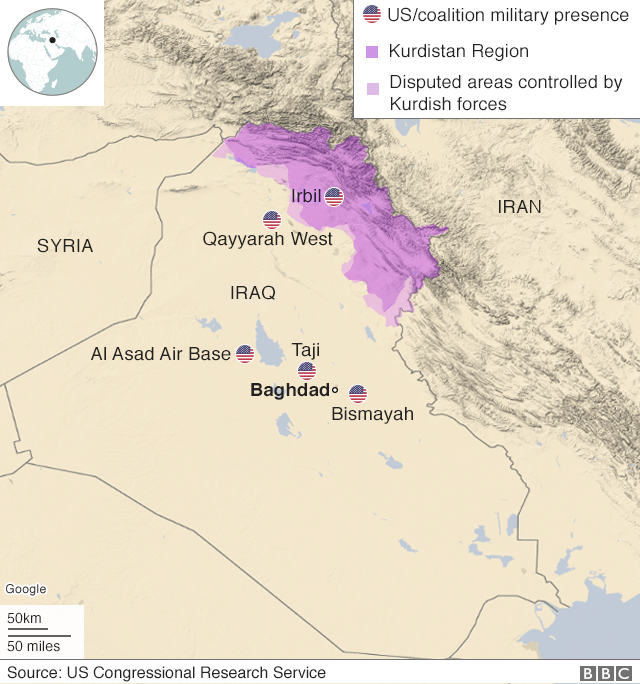
Following the recent assassination of General Qasem Soleimani of Iran, in what appears to be retaliation for this US-backed attack US troops have been targeted with ballistic missiles in Iraq, where Iran has recently maintained a heavy military presence. As of the time of this post, no fatalities have been reported. Tensions surrounding this attack have been exacerbated by contradictory messages from President Trump and his administration, the former promising "disproportionate retribution" if Iran were to antagonize the US, potentially including attacks on Iranian cultural sites (a war crime), and the latter denying any intent to commit war crimes. Many have criticized Trump's apparent hotheadedness in geopolitics, as he is often incited to conflict or seemingly unaware of the consequences of his words; on the international stage, where a flippant remark may result in stock prices plummeting or vigilante retaliation, there is little room for impulse.
Questions/Discussion Topics:1. Many in Iran and abroad have described General Soleimani as a "martyr"; the top general of the Revolutionary Guard, Iran's military, said "The martyr Qasem Soleimani is more powerful... now that he is dead." What do you think the ramifications of this idea will be in the coming weeks? How can someone be more powerful when dead?
2. There have been many reports of Iranian nationals and Iranian-Americans being detained on the border of the US and asked questions about their political allegiance. Is this a legally or morally justifiable practice? If conflict between Iran and the US were to escalate, could we see the level of scrutiny afforded to Iranian-Americans and Iranian nationals in the US increase? Consider historical connections, for instance the detainment of Japanese-Americans during World War II.