Wednesday, October 30, 2019

Democratic hopeful Warren vows to bar corporate giants from hiring ex-officials


link to article

Possible presidential nominee, Elizabeth Warren, said that she would work to stop large corporations from hiring former senior government officials for at least four years, in an effort to decrease the influence of big money in government. She defined "large corporations" as any corporation that is worth more than $150 billion or has a great deal of control over their industry's market. She has incorporated several measures into her proposal aimed at getting rid of the "revolving door" between lobbyists and the government. (The revolving door is a term used to describe the process of the government hiring industry professionals for their expertise and connections to campaign donations, and in turn, the industries hiring ex-government officials to gain access to more sectors of government.) The proposed penalty for breaking this policy would be a fine equal to 1% of the company's net profit, which could be hundreds of millions of dollars for the bigger companies.

Questions:
1. If she becomes president, do you think Warren could successfully implement a policy like this?

2. If she is able to put this policy to action, is the penalty enough to deter companies from breaking the policy, or should there be more of a penalty?

3. Do you think the "revolving door" is something that needs to be addressed right away, or are there other issues that candidates should be focusing on first?

Tuesday, October 29, 2019

Trump impeachment: Officer Alexander Vindman raised alarm over Ukraine call

https://www.bbc.com/news/world-us-canada-50223635


Colonel Alexander Vindman was one of the few officials who listened in on the infamous July 25 call between Trump and the Ukrainian president, where the original discussion of the "quid pro quo" sparked. This call, in addition to many other factors, led to the ongoing inquiry, addressing abuse of executive power by Trump and his associates, national security, and America's role on the political stage. Many have argued that Trump's actions fall under the sphere of standard interactions between world leaders, while many like Vindman have described them as "improper." Some have criticized Vindman for potential dual allegiance, as he was born in Ukraine; still, even if these questions undercut the legitimacy of one witness, as a whole the inquiry is untainted.

Questions:
1. What should normal interactions between world leaders look like? As discussed so far, do Trump and Zelensky's interactions fall under this paradigm?
2. How is it possible to tell if someone's political bias undermines their judgment in politically-charged cases such as this impeachment inquiry? Are there instances of this occurring so far?
3. Is Trump accurate in calling this inquiry a "witch hunt"? Why or why not?

Saturday, October 26, 2019

The Deadly End of American Policy in Syria

Link Here


This month, Trump pulled U.S. troops out of northern Syria, clearing the way for a Turkish invasion. Previously, in concert with the Syrian Democratic Forces(SDF), the U.S. troops had cleared a large swath of land in northern Syria of ISIS, making it a safe zone guarded by U.S. troops. However, removing those troops puts the entire region in limbo. After losing this safe zone, many of the U.S.-allied Syrians still in the country are debating whether to stay and face the tenuous future of Syria or escape while they can. Throughout the eight years of the Syrian civil war, allies of the U.S. have seen a recurrent pattern: "America largely looked on as its allies were decimated." This holds true for the nonviolent allies in Syria as well. Aid workers, medical teams, and journalists have all been regularly targeted by ISIS, without any significant response from the U.S.

Questions:
1. Did Trump make the right choice in pulling out U.S. troops from Syria?
2. Should the U.S. respond to the Turkish invasion? If so, what action should be taken?

"What About All The Good Times?" Says Cornered President

http://bit.ly/2JpM7bR


In a recent press conference, Trump exhorted the media and the American population as a whole to focus on the positives of his administration in light of recent unpleasant news, arguing that everyone is "just focusing on the negative here". This was prompted by recent revelations about the impeachment inquiry, including that a judge had ordered records from the Mueller report unsealed in light of their potential relevance to the inquiry. Some have criticized Trump's recent remarks as "deflection," saying that his focus on the past as "a real hoot" is inappropriate given the circumstances. Trump has had a history of making untimely remarks, especially recently with his simultaneous denial of a "quid pro quo" with Ukraine while also implying he did the same with China. Whether this is a premonition of the end, characterized by his increasing disarray, or a sign of great confidence has yet to be determined.


Questions:
1. Are Trump's recent appeals to focus on "the good times" a sign of desperation? Are they appropriate right now?
2. Based on this recent press conference, where Trump reminisced about infamous incidents like his "covfefe" remark, do you think Trump is not taking the impeachment inquiry seriously enough?
3. Following from the above, is it appropriate that Trump considers the "covfefe" incident, as well as the taco bowl post and other events widely mocked in the mainstream media, highlights of his presidential career over topics more pertinent to foreign policy?

Friday, October 25, 2019

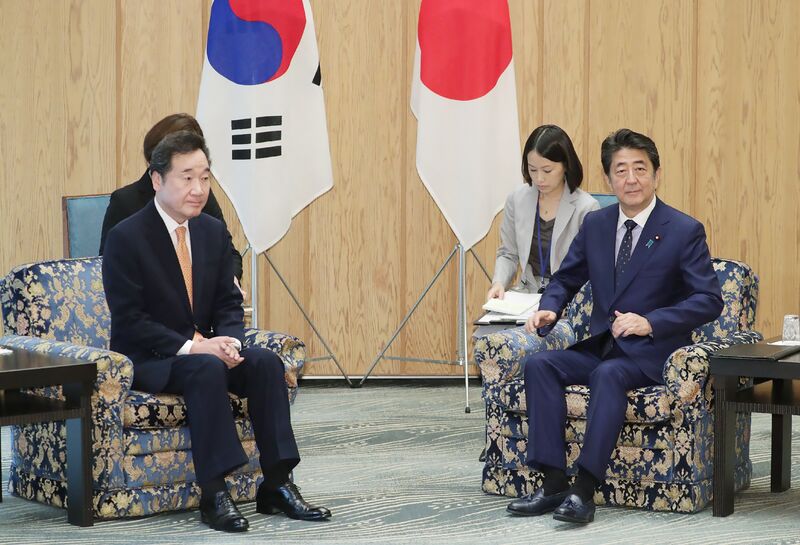
Japan, South Korea Agree to Mend Ties After Ice-Breaking Talks


JAPAN-SKOREA-DIPLOMACY


For the past 3-4 months, Japan and South Korea have been waging a major trade war against each other, each pulling out the other's companies and products out of their markets and greatly affecting each others economy. Incidentally, despite this being a modern issue, the reasoning for this trade war goes back to the period of Japanese colonial rule over Korea during WWII. The conflict in particular revolves around the issue of "comfort women", or Korean women taken as sex slaves by the Japanese military to be used as means for reducing stress of Japanese soldiers. This and other things being a devastating blow to the legacy of Japan's colonization of Korea and also a great act of wrongdoing to Korea, the South Korean government demanded for reparations in 1951. 

Japan initially paid Korea around $364 million as compensation to victims of forced labor during Japan's colonial rule, with $200 being allotted to each individual survivor, $1650 per each death, and $2000 per each injured victim. In 1965, the Treaty on Basic Relations between Japan and the Republic of Korea was signed, seemingly finalizing diplomatic relations between Japan and Korea post WWII, with Japan paying $800 million in total as "economic cooperation". 

However, South Korea brought up the issue again in recent years, with its Supreme Court demanding that several Japanese companies pay grievances to South Koreans who were forced to supply labor during WWII. Japan on the other hand, argued that the issue of reparations and grievances was already settled and finalized in the 1965 treaty, sparking a great trade war between the two disagreeing countries. After nearly 4 months, Japan and Korea finally seem to have begun peace talks and an effort to a solution to this great issue.

1) On August 2nd, Japan removed South Korea from its list of favored trade partners. How do you think the US, being allies with both Japan and South Korea might be affected by this or might handle this issue?

2) How might Japan and South Korea go about mending relations?

3) What is your stance on the issue of grievances if there is any?

Thursday, October 24, 2019

The Age of Appeasement?

   
- Article Link -

Image result for nba china

     Recently the NBA has been receiving increased scrutiny for an apparent appeasement of China’s Communist Regime. When Houston Rockets General Manager Darl Morey posted  "Fight for freedom, stand with Hong Kong," on twitter, he was met with forceful pushback. He received so much opposition in fact, that he removed his comment altogether.This is partially due to the fact that China houses a significant percentage of the NBA’s fan base and commercial success.

      Despite this being a major concern, however, this issue does not just lend itself to the NBA, but to other outlets.This is interesting in the light of corporations and industry groups having made modifications to the products and content that is to be released overseas.
      Hollywood and other similar film industries have even admitted to making alterations to box office films in order to boost revenue sales abroad. This was also due in part to the increasing assertiveness of the Chinese government to censor media and other influences that do not play to the ideals of the Communist party. This idea, of how major companies and corporations have been satisfying China's government,  was humorously portrayed in a South Park episode, ironically resulting in the sudden ban of it in China.

      At this current climate it seems as though many individuals are offended by comments or statements that do not align with their world-views.

--- Which begs the question; why should we change our opinions to appease those around us and conform to a popular ideology, if dissent and discourse is an essential part of the democratic process? ---

~I am interested in your thoughts on this…

1.) How is “call-out culture” and “social justice”, affecting the standing of society as a whole? And what may be some unintended consequences of these movements?

2.) How could the major industries and corporations better negate the situation abroad?

3.) Is being politically correct significant if the underlying meaning or idea that is being conveyed is somehow opaque or avoided?

The Corruption of Great Meadow Correctional Facility

Inmate John McMillan Murdered by Prison Guards


In January of this year, John McMillan died of what the medical examiner declared to be a heart attack, but many eye-witness inmates disagree with this ruling. The New York Times interviewed those who claimed to witness a struggle between McMillan and the guards, who, they say, beat McMillan to death. 
        McMillan, in the past, had altercations with guards due to violent behavior, as he suffered from mental illness. However, he had been behaving since those altercations due to his nearing date for a parole hearing. Inmates say that McMillan was not following orders of guards, but also not acting violently when one of the prison employees punched him in the face, leading to other guards joining the scuffle and ultimately beating McMillan to death. One inmate reported having seen a guard attempt to strangle McMillan into submission.
          This incident is not unique when it comes to Great Meadow Correctional Facility. Violence within the facility between inmates and guards alike seems to be widespread, so much so that Governor Andrew Cuomo toured the prison while it was on lockdown following a particularly bad fight between inmates. At this time, one guard was suspended due to accusations of violence toward inmates. The prison is said to have become and example of why nationwide prison reform is necessary, as supported by the Governor. 
       Guards accused of beating McMillan have denied the accusations by inmates, claiming that McMillan attempted to grab one of them, thus making force a necessary evil in order to protect themselves. The prison declined to release body camera footage from the time of the incident, 5:25pm on January 22nd. Medical assistance and an ambulance did not arrive at the scene until over an hour later at 6:40pm, and McMillan arrived at the hospital already deceased 34 minutes later.
        Unrelated to the incident, several other inmates at Great Meadow have filed lawsuits against the guards for unwarranted violence and unusual cruelty toward inmates. Additionally, some have reported instances of guards punishing those who testify against them. 

Questions:

1. What can the government do in order to ensure the safety of inmates at prisons like the one described above?
2. Should there be a requirement for extensive medical staff to be on-site for large prisons in the event that inmates need immediate medical attention?
3. How can corruption of prison guards be stopped? Is there a way in which behavior can be more closely monitored?